Showing posts with label umbria. Show all posts

Tuesday, January 24, 2017

Italian Wine Classification – What Does it Mean?

When you are in the store purchase wine from Italy you see labels with DOCG, DOC, IGT and Vino de Tavola, what does it all mean? It’s the Italian wine classification system. Pretty much it dictates what grapes go in the bottle. Let’s take a look at each classification.
DOCG is the highest quality of wine under the Italian wine classification system. There are strict rules governing the production of wine that can carry this classification. There are certain permitted varieties, yield limits, how ripe the grape is when harvested all the way to the wine making procedures. The wine bottles all have a numbered government seal across the neck to prevent counterfeiting. Each region differs with what DOCG classification entails.
DOC is the main tier and there are 330 DOC areas with their own set of laws in their viticultural area. Laws that include the permitted grapes allowed and the wine style produced.
IGT was orginally introduced in 1992. Prior to that when winemakers wines failed to qualify for the DOC or DOCG status because of the grapes that the wine was made from, not from quality. These wines must be produced from at least 85% of the grape variety. This category has allowed producers to produce creative wines and allows then to export their product.
Vino da Tavola is the Italian classification for table wine. This is the most basic level of wine. It is the lowest on the classification system. These wines tend to be inexpensive and a blend of wines from different regions and at time different vintages.
Below find a wine from each category. Note there really isn’t a huge difference in price. All three were very good.
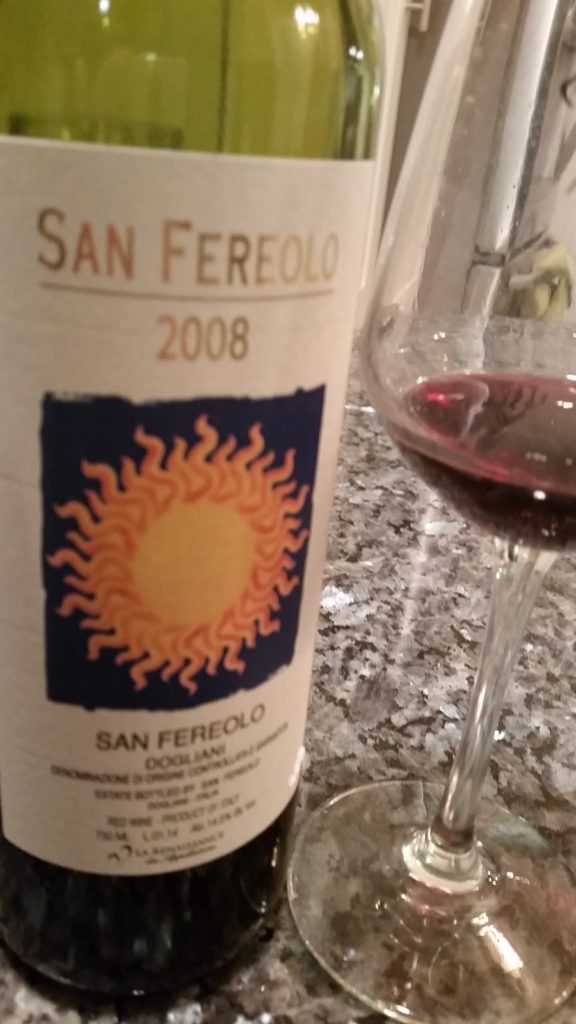
San Fereolo, Dogliani DOCG 2008 comes from the Piedmont region of Italy and is made with 100% Dolcetto. Winemaker Nicoletta Bocca delicately produces this wine from a small part of an ancient 1400 foot vineyard and 80 year old vines that sit on a hillside above the Piedmontese village of Dogliani. The grapes are fermented in large neutral Slavonian oak vats. You can smell the limestone soil as it shows in the nose as wet stone and hints of voilet. Intense flavors of anise, blackberry, pine resin and dark fruit show in the glass. This is a very powerful wine that knocked my socks off. As it opened it got softer and the fruit really began to shine with soft tannins and nice acidity.  SRP $30

Castello Di Magione Morcinaia Vendemmia DOC 20 08 from the Umbria region of Italy. This is a blend of 40% Cabernet Sauvignon, 40% Merlot and 20% Sangiovese. This wine is full of red and black fruit. Blackberry notes stand out with some earthy tones rounded out with some cherry. You get a bit of the acidity from the Sangiovese grapes and tannins that show this wine still has time to age. SRP $35
Le Boncie 2014 Toscana is a IGT classified wine estate bottled by Le Boncie in Castelnuovo Berardenga, Italy. This is a decent everyday wine.  Notes of black cherry, clove and vanilla escape from the glass. On my palate it was light and thin with flavors of black cherry and raspberry with some spice finish on the tip of my tongue.  The SRP is $23.

Tuesday, September 27, 2016

5 Facts Everyone Should Know About Umbria's Sagrantino Grape


*This tasting and seminar took place just hours before the earthquake.  My thoughts go out to the people of Umbria and LeMarch. If you would like to help in the relief efforts visit Italian American Relief or the Italian Red Cross.

Umbria is located in the middle of Italy. It borders Tuscany to the north, Le Marche to the east and Lazio to the west. It has rainy winters and sunny summers. It is referred to as  "Green Heart of Italy" because of  the rolling hills and ancient towns.

When visiting Italy, the easiest way to get to Umbria  when you visit Italy is a train from Rome. Joining us during this conversation was Giselle Stafford who with her husband Mark own Gusto Wine Tours. If you are planning a trip to Italy, I suggest getting in contact with Giselle who can arrange day trips to many of the wineries in Umberia including Fongoli which is the wine reviewed below.

In addition to the Sagrantino grape which we'll discuss in a minute, Umbria is also known for Orvieto which is a blend of the Grechetto and Trebbiano grape. It's a nice dry white wine.


There are 6 facts you should know about Umberia's Sagrantino Grape:


  1. Sagrantino the wine of Montefalco was originally made as a dessert wine, In 1979 the DOC allowed it to be made as a dry wine.
  2. Vino Secco which appears on the label means dry and is displayed as so  because it was once only made sweet.
  3. The Sagrantino grape is onlly grown around the hilltown of Montefalco.  You will not find it anywhere else in the world.
  4. Sagrantino grape is a very tannic grape. One of the most tannic grapes in the world.
  5. The leaves of the Sagrantino vine turn bright red by the end of October


I was very fortunate to be able to taste a 2010 Fongoli Montefalco Sagrantino DOCG.  Montefalco Sagrantino DOCG dictates that the wine is  100% Sagrantino grapes that is aged for 12 months in oak for a total of 37 months of aging.

The Fongoli family has over 80 years of winemaking in the Montefalco area. The San Marco Estate was purchased in 1927 and since then it's been passed down through three generations.  The grapes are all hand harvested and aged in large Slovenian oak barrels from 5 to 40 years.

The 2010 Fongoli Montefalco Sagrantino is aged for 30 months in large Slovenian oak barrels then 6 more months in the barrel. This wine is a very full bodied and  bold wine. But yet after decanting has a soft and elegant side.

Yes this wine needs to be decanted at least an hour before entertaining the first sip. You can smell the boldness coming out of the glass with the oak and dark fruit.  As the wine enters your mouth it's got a soft and beautiful feel.  Dark fruit leads the way with tannins that make it a little chewy.  Hints of black cherry plum and some clove with a bit of cigar box on the finish. This wine is very well balanced and a real treat.

I paired this with a  grilled rib-eye steak that I seasoned with Montreal seasoning and sprinkled it with truffle dust. I served it with sauteed mushrooms on top.  Just a tiny bit of the truffle dust really blends with the wine to bring out the wonderful flavors of both the wine and steak.